For decades, the incandescent light bulb was the standard choice for lighting our homes. It was a familiar, simple technology that worked. Today, however, LED (Light Emitting Diode) technology has become the dominant force in the market. If you've ever wondered about the real differences between these two types of bulbs, you're not alone.
This article breaks down the fundamental differences between LED and incandescent bulbs to help you make more informed lighting choices.
| Feature | Incandescent light | LED Light |
| Energy Efficiency | Very low; wastes ~90% of energy as heat | Very high; uses over 75% less energy and produces little heat |
| Lifespan | Short; around 1,000 to 2,000 hours | Long; can last 50,000+ hours |
| Cost | Low upfront cost, but higher long-term energy and replacement costs | Higher upfront cost, but much lower long-term costs due to energy and replacement savings |
| Heat Emission | High; produces significant heat | Low; produces very little heat |
| Durability | Fragile; glass bulb and thin filament are easily broken | Durable; often made with epoxy lenses, making them more resistant to breakage |
The primary difference lies in the technology used to create light.
Incandescent Bulbs: These traditional bulbs work by passing an electric current through a thin wire filament, typically made of tungsten. The filament heats up until it glows, producing both light and a significant amount of heat.
LED Bulbs: LEDs are solid-state semiconductors. When an electrical current passes through the microchip, it illuminates the tiny light sources called LEDs.
A LED light bulb is a light-emitting diode that works by passing an electrical current through a microchip. This illuminates the bulb, resulting in visible light. LED bulbs are energy-efficient and last a long time.
An incandescent light bulb is a bulb that utilizes electricity to heat a wire until it’s hot enough to emit light. This lighting selection is standard in commercial businesses because they’re easy to install and cheap. However, this guide will uncover the drawbacks of this bulb option.
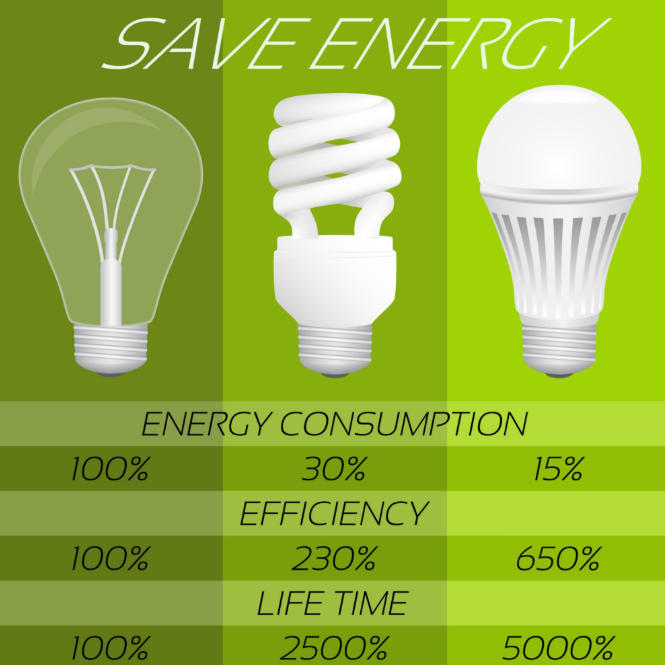
Energy Efficiency: This is the most significant difference. Incandescent bulbs are highly inefficient, with roughly 90% of their energy being lost as heat rather than used for light. LEDs, on the other hand, are incredibly energy-efficient, converting a much higher percentage of energy into light.
Heat Production: Because of how they generate light, incandescent bulbs get very hot to the touch. LEDs run much cooler. While they do produce some heat, it's absorbed by a heat sink at the base of the bulb, meaning the bulb itself remains relatively cool.
Lifespan: LED bulbs have a vastly longer lifespan than their incandescent counterparts. A typical LED can last for tens of thousands of hours, while an incandescent bulb usually lasts only about 1,000 hours.
Durability: Incandescent bulbs are fragile because they rely on a delicate glass envelope and a thin filament that can easily break. LEDs, being solid-state devices with no fragile filament, are much more durable and resistant to breakage.
Cost: Incandescent bulbs have a very low upfront cost. LED bulbs are more expensive to purchase initially. However, due to their long lifespan and high energy efficiency, LEDs save a significant amount of money on energy bills and replacement costs over time.
In summary, while incandescent bulbs may have a lower initial price tag, LED bulbs offer a modern, energy-efficient, and durable alternative that provides long-term savings and better performance.
Looking for the best smart lighting? Discover th
Ultimate Guide to Neon Indicator Lamps: Types, T
Looking for the best LED dimmer switch suppliers
Contact: Jack Wong
Phone: +86-133-9238-9099
Tel: +86-760-85321980
Email: info@chinalightbulbs.com
Add: #627 Dadong, Qitou, Dongguan, Guangdong, China


 English


